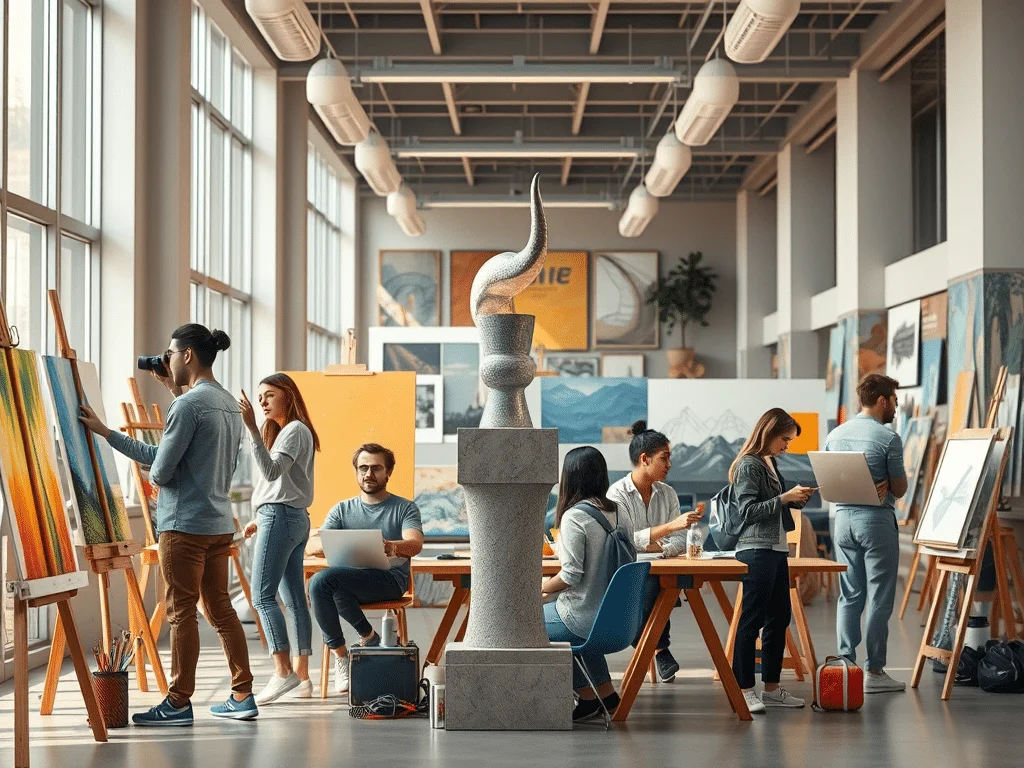
The Ultimate guide to art courses.
This guide is full of tips on how to maximize on your next course or class in art.
We have tips on confidence boosting to tips on studio etiquette and tips about art courses in general and art tutors are on hand to provide their professional counsel.
How to select the appropriate course in art.
1. What am I already good at?
Although we are here to learn, art is a continuous process, and finding out what you already know that you can develop will help you develop. In the event that you like creating good replicas of photographs, maybe a strict sight-size portrait course would be a step into the right direction? Are you a draughtsman and would a workshop in a linocut printmaking interest your drawing ability? The majority of the places will be too pleased to recommend art courses to you in order to suit your needs once you call them.
2. What drives your curiosity?
When we decide to take a path, we are likely to reason in subjects or media. An instance would be that it would be a no-brainer to an artist who enjoys painting landscapes to join a course on landscape painting. However, it can also be equally relevant to question yourself what aspect of the topic is interesting to you or what aspect you may wish to study further otherwise you may find yourself merely drilling through what you already know in a classroom.
Do you take colour as your greatest delight? In case, a course in the studio, with emphasis on the palette, would prove a surprising help to plein air painting. You are more interested in abstraction of the landscape? The most fulfilling is a more expressive workshop involving mark-making.
3. What level am I at?
It is significant to have a truthful assessment of yourself. Choosing an art course that you do not have the ability to do is the fastest means of putting off an eager novice. Similarly modesty can ensure timid artists do not go to the extent of pushing themselves.
Suppose that the only course you have next term is called advanced, does this mean that you must have had an entry level course? Do you have a choice procedure you need to pass through initially in case you want to apply to a diploma or full time course? Consider these or put them into consideration.
4. What are the costs?
Although good tuition is priceless, in times of hardships it is worth considering all the expenses beforehand. The cost of the course is not the only thing to consider, but also traveling to and out of the school, the need to stay somewhere or not, and content covered in the price. You also should not hesitate to ask what degree and type of tuition you will get. Classes are important because contact time with a tutor is valuable.
5. Which teaching style do you think would be the most effective response to you?
Novices or less confident individuals can be helped by a more positive attitude. Domestic studio courses directed by artists may be a less intimidating prospect, in that case. Lindy Allfrey, who teaches portrait at her Cotswold studio, says that a small class would be a good place to begin as a new student will require a great deal of instruction.
There are those tutors who just want to demonstrate and there are those who want to tell you of your progress. Do you prefer to be guided by the hand or pushed in the right direction? In case you feel like having practical skills to learn on a more intensive programme, you can look at a school that provides an atelier-style of training. Everyone applied this academic style, beginning with Leonardo da Vinci through John Singer Sargent and it included cast drawing, sight-size and other academic training that is centuries old.
6. How long should I commit?
Courses in art can be absorbing and exhausting especially when you are introductory to the same. New learners can take into account a one-day taster course to check whether the topic and location suit them and then make up their mind to have a more permanent course of studies.
Greater discipline artists might find it better to attend a weekly session with a week to think about what you have learned in between, whereas a week-long course with immersion into a topic should be considered by anyone eager to do everything to immerse subject. Whichever option you take make sure that you will manage to balance your other commitments with your education. When you miss a course because of other commitments, it will become so useless.
Preparations in advance to take an art course.
Sue Spaull of Art Academy talks about what you should take into consideration during the run up to a new course.
1. Manage expectations
Students who are nervous must remember that their tutors are not asking them to write a masterpiece in their first class with them, or in all likelihood, anytime they are taking their first art courses. Painting or drawing is a matter of learning how to work with the blocks and as such all classes in art will commence with simple exercises that will familiarize you with handling paint, mixing colour or creating marks.
2. Consider your purpose
You should also consider the reason why you are doing a class. Each student is first painting or drawing personally. With time, you may wish to create some form of work to display or sell. The first class is, however, a secret of its own. The problem of art is that people can always peep at what you are doing. But when you still have the idea of doing it by yourself, and it will not matter what the rest of the people think about it, you will be more confident. There is no one to judge you as a beginner. One should never be afraid of making mistakes as it is a necessary step to do anything, except to make art. It is actually true that there is not always a single right answer to art.
3. Get organised
You always want to have everything you need packed the day before, so that you do not have to go searching in your cupboards the day of your lesson: you do not want to show up late and disheartened. Such a list of the materials we will require during the class will be given to you at the Art Academy, as in most schools. Read this at least a week before the course, so that there is no chance of being caught short of something.
As a painting course, you will probably require a set of brushes, a brush cleaner/medium such as Sansodor, a palette some basic colours of paint, rags, an apron and one or more supports canvases or boards to paint on. Drawing materials will be probably in need of various pencils, rubber, sharpener, charcoal, putty rubber and possibly some paper. One of the things you should do on the day your class is to arrive early enough, so that maybe you can prepare yourself in the studio, greet your tutor and fellow students and have your materials lying down.
4. Revive your innocent children.
Most importantly, keep in mind that creating art is truly entertaining and it is not about proving something to yourself, how well you can be graded according to something unspecified. Consider the process of learning by doing that children should go through, and the fun they have when they are playing around with their materials and the trace they leave. Re-establish communication with that inner child in you. What to do to feel better about your confidence in an art lessonYou will not be the only amateur.
Anxiety on the first day in a classroom or the first encounter of a new subject can always be an intimidating event regardless of whether you are a first-time visitor to that classroom. There is no need of nerves though, as Jem Bowden, a tutor in art at the Big Sky Art in Norfolk, explains. Remember when you get on a course you are all in the same boat as you are and you have nothing at all to live up to, he says.
It is usually a very mixed group, with beginners in it, and those who are experienced, who may have attended numerous painting courses but do it as a hobby. In case you are not certain about whether the course will be suitable to you, then call the tutor up and have a chat with him or her before making a reservation.
Get to grips with your tools
Getting used to your equipment is a simple method of increasing your confidence prior to joining the class, but your preparation before class does not have to stop there. Should you feel nervous about working outdoors and it will be the first time of your life that you will do it, it may be a good idea to give it a test run somewhere secluded, before coming to the course, advises Jem. The village cemetery can be perfect. You can get a quiet spot and sit and not see a soul. This will allow you to put your materials to the test and how they work in an outside setting and whether you have remembered all that you may require in the course. And fear all about the success of your painting, You see.
No need to stress until your eyes sink in.
A variety of art classes will guide you through exercises that will provide you with the opportunity to experiment with different techniques and only after that will you get to work on the final painting, thus not everything that you will create will result in the aesthetically pleasing outcome. Use this as a chance to free up – the less you are obsessed about the final result the more free you will get into it. As Jem points out, once you are on a course, all you need to focus on is to have a good time, and not to expect a lot of the paintings. Excessive expectations may have a disillusioning effect. Practice makes perfect, as such, that will come over time. You had better keep the attitude of keeping the mind on a go playfully, without putting the strain over it.
The question of what to do when you have finished your art class.
You can keep the learning process going after the class provided you find time to reflect and learn to criticize yourself as St Ives School of Painting tutor Liz Hough offers.
One does not just work merely after finishing an art class. When you walk out the door you are supposed to be full of ideas of how to practice and improve. In addition to reviewing methods which were implemented during the lesson, the break between classes is a good opportunity to review your work, reflecting on what you have learned in order to define aspects of your work which should be improved in a reasonable and constructive manner.
With that said, it is easy to get in the habit of being too critical when examining your own work, hence some of the best tips to critique your artwork in a manner that will help the practice.
1. Compare to your aims
Be it a completed work or even just a couple of sittings to complete, glance back upon what you have done and remember how you thought of it in the first place. Have you strayed from it? In that case, what have been the strengths of your initial design and what are the things that could be improved? The following are some of the points that you should consider when you begin to compose something.
2. Consider a series
Find a spot in the work that interests you, something that is working well. Imagine it as the main event, which would potentially become a starting point of new work or even a series. Also, it can be useful to seek things that did not go around right. Consider them disappointments and not failures: what would you have done in a different way?
3. Be prepared to sacrifice
See the bigger picture and look at the way the whole work is coming together. You might have to abandon a favourite portion in the composition to suit.
4. Look for a new angle
An actual alteration in the perspective on your own work in the most practical meaning can go a long way in helping you diagnose the possible issues. Attempt to turn the canvas, view it oblique, upside down or even in a mirror. Such a new perspective will provide you with a more in-depth insight into the balance and emphasize aspects that are not functioning.
5. Get some distance
The space of time will also be useful in making you bring new eyes to a piece and you can always go back to what you are working on a few days later and see what speaks to you. Lastly, the change of scenery itself can contribute to a real difference, in that case, when you continue to find it difficult to look objectively, then go out of the studio and put your work up against another wall or go even in the garden.